

China Times Financial News, March 22, Page B2
Reported by Chen Fengying / Taipei
Taiwanese people love starting businesses and becoming their own bosses. Influenced by living in Taiwan for a long time, foreigners residing in Taiwan have also recently sparked a wave of entrepreneurship. Although foreign nationals face much higher barriers to starting a business than locals due to language and cultural differences as well as legal restrictions, many foreigners still enthusiastically devote themselves to entrepreneurship.
Foreigners Spark an Entrepreneurship Boom in Taiwan
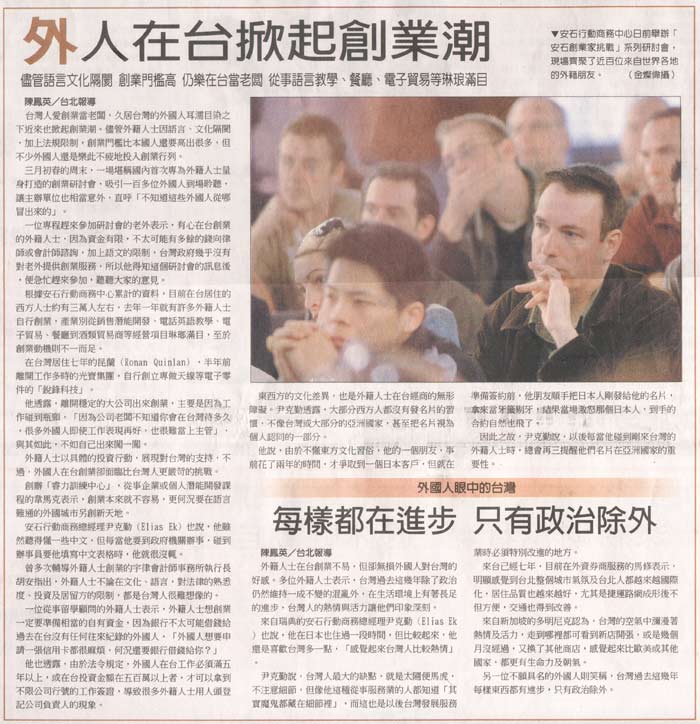
On a weekend in early March, a startup seminar specially tailored for foreigners — believed to be the first of its kind in Taiwan — attracted more than one hundred foreign attendees, surprising even the organizers, who exclaimed, “We had no idea where all these foreigners came from.”
One foreign participant who made a special trip to attend the seminar explained that foreigners interested in starting businesses in Taiwan often have limited capital and cannot afford to consult lawyers or accountants. Combined with language barriers and the lack of startup support services provided by the Taiwanese government for foreigners, he hurried to attend the seminar as soon as he heard about it, hoping to listen to others’ advice and experiences.
According to data compiled by An-Shi Mobile Business Center, there are currently around 30,000 Western residents living in Taiwan. In the past year alone, many foreigners have launched their own businesses across a wide variety of industries, including sales potential development, telephone English teaching, e-commerce, restaurants, and alcohol trading. Their motivations for entrepreneurship also vary greatly.
Ronan Quinlan, who has lived in Taiwan for seven years, left the Lite-On Group half a year ago to establish his own company, “Rui Feng Technology,” specializing in antennas and electronic components.
He revealed that the main reason for leaving a stable position at a large corporation was career stagnation. “Because company bosses never know how long you’ll stay in Taiwan, many foreigners find it difficult to be promoted to management positions no matter how well they perform,” he explained. Rather than remaining stuck, he decided to venture out on his own.
Foreign entrepreneurs are demonstrating their support for Taiwan through concrete investments, yet they also face much harsher challenges than local Taiwanese entrepreneurs.
Mark Whitman, founder of the Rui Li Training Center, which offers personal and corporate potential development programs, noted that starting a business is already difficult, let alone building a new future in a foreign city where language barriers exist.
Elias Ek, general manager of An-Shi Mobile Business Center, added that although he understands some Chinese, he often feels helpless when dealing with government offices and being asked to complete Chinese-language forms.
Hu An, CEO of Yu-Lu Accounting Firm, who has frequently advised foreign entrepreneurs, pointed out that challenges involving culture, language, legal familiarity, investment regulations, and residency restrictions are difficult for Taiwanese people to fully imagine.
One foreign study-abroad consultant explained that foreigners wishing to start businesses in Taiwan must prepare substantial personal capital because banks are unlikely to lend money to foreigners with no prior financial history in Taiwan. “It’s already difficult for foreigners to apply for a credit card,” he said. “How could banks possibly lend you money?”
He further revealed that, according to regulations, foreigners must either work in Taiwan for at least five years or invest more than NT$5 million in Taiwan before they can obtain an unrestricted work permit. As a result, many foreigners resort to registering companies under another person’s name.
Differences between Eastern and Western culture also create invisible barriers for foreign entrepreneurs in Taiwan. Elias Ek explained that most Westerners are not accustomed to exchanging business cards, unlike Taiwan and many Asian countries where business cards are regarded as an extension of personal identity.
He shared a story about a friend who spent two years securing a Japanese client, only to lose the contract moments before signing because he casually used the business card he had just received as a toothpick. The Japanese client was immediately offended, and the deal collapsed on the spot. Since then, Elias Ek said he always repeatedly reminds newly arrived foreigners about the importance of business cards in Asian cultures.
Taiwan Through Foreign Eyes
“Everything Is Improving Except Politics”
Although entrepreneurship in Taiwan is not easy for foreigners, it has not diminished their favorable impressions of Taiwan.
Several foreigners remarked that, aside from Taiwan’s persistently chaotic political environment, the country has made remarkable progress in living conditions over the years. Taiwanese people’s warmth and vitality have left a deep impression on them.
Originally from Sweden, Elias Ek said he had also lived in Japan for some time, but still prefers Taiwanese people because “they feel warmer and friendlier.”
He added that Taiwanese people’s biggest weakness is being overly casual and inattentive to detail. However, as someone working in the service industry, he understands that “the devil is in the details,” and believes Taiwan must improve in this area as it continues developing its service sector.
Matthew, who has lived in Taiwan for seven years and currently works for a foreign securities firm, observed that both Taipei’s atmosphere and its residents have become increasingly internationalized, while the quality of life has steadily improved. In particular, the completion of Taipei’s MRT network has greatly enhanced convenience and transportation.
Dominic from Singapore believes Taiwan’s atmosphere is filled with passion and energy. Everywhere he goes, he sees new stores opening or businesses changing within just a few months, making Taiwan feel more vibrant and dynamic than Europe, America, or many other countries.
Another foreign resident, who wished to remain anonymous, joked that over the past several years, “everything in Taiwan has improved except politics.”