B2B business development efficiency is a critical competitive battleground for enterprises. This article reveals why leveraging data to enhance organizational performance, through systematized and process-driven approaches, transforms “unpredictable individual potential” into “a forecastable business development engine.”
What Is B2B Business Development? How Is It Different from Sales?
B2B business development is a strategic initiative for enterprises entering new markets and expanding their customer base. At its core, business development requires identifying target market segments and reaching key decision-makers. However, according to Gartner research, the average B2B purchasing decision involves 6 to 10 decision-makers, each applying different evaluation criteria, making closing on the first contact nearly impossible.
Furthermore, the Enspyre 2025 Satisfaction Survey showed that 87% of Taiwanese enterprises identified “difficulty reaching decision-makers” as their greatest challenge, not product capability or pricing.
B2B Business Development Challenges: Why Is Reaching Decision-Makers So Hard?
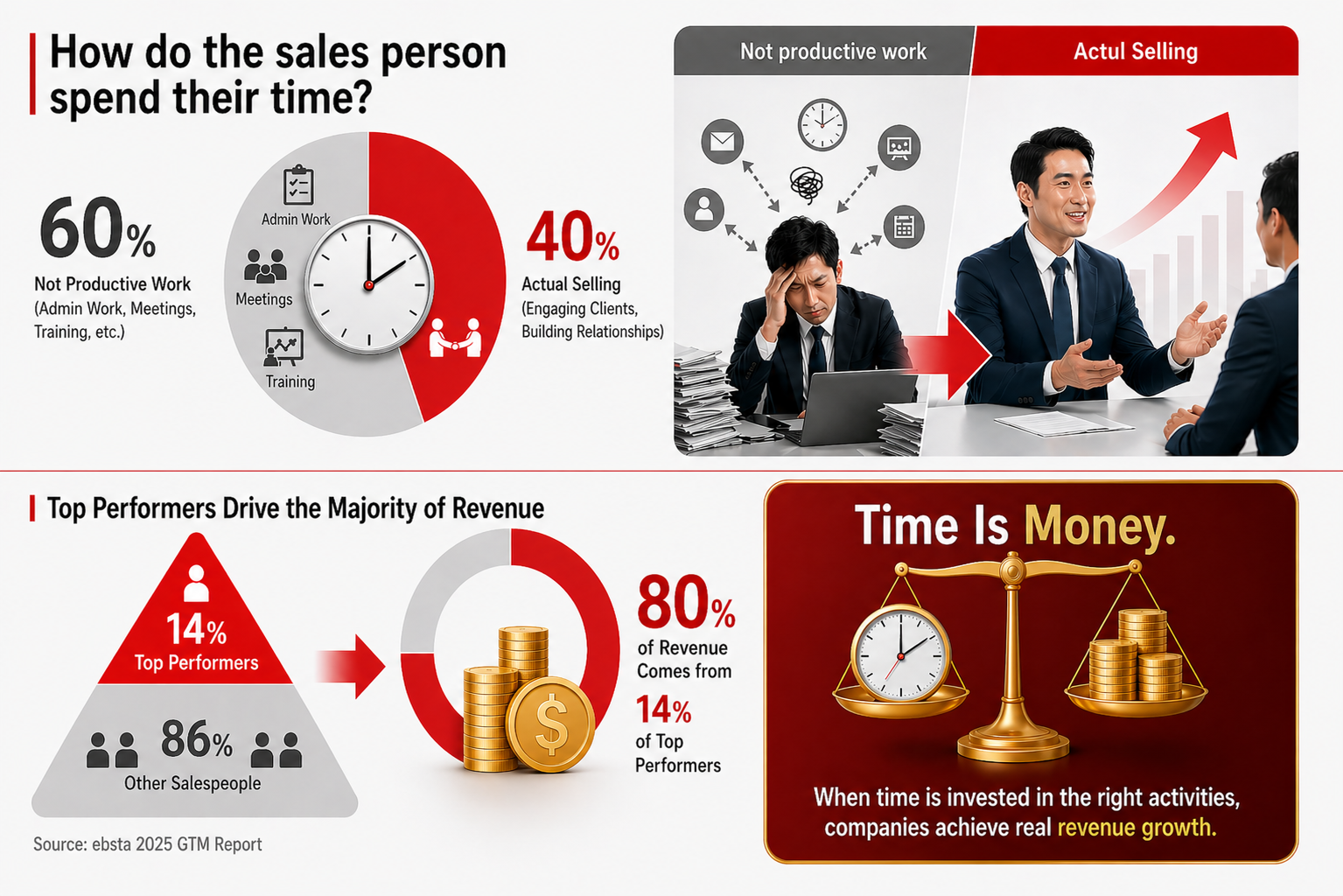
Many enterprises fall into the same trap when pursuing new opportunities: sales teams spend excessive time making unfocused outreach, crowding out the time needed for actual contract negotiation and relationship building. The Salesforce State of Sales 2026 found that sales representatives spend only 40% of their week on actual selling activities, with the remaining 60% consumed by administrative tasks, meetings, and training.
Both practical experience and data point to the same gap: companies expect revenue growth, yet allow their salespeople to spend most of their time on activities unrelated to selling.
“A salesperson’s time is money.”
This is confirmed by the Ebsta 2025 GTM Report: 80% of revenue within an organization is generated by just 14% of top-performing salespeople, with an 11x performance gap between top and bottom performers.
Leading enterprises such as Oracle and Salesforce recognized this early. To improve close rates, they established Inside Sales teams dedicated to prospecting and qualifying leads, passing only confirmed opportunities to senior salespeople for closing.
The Inside Sales model was a landmark shift in sales management in the 2000s, breaking down the initial “non-face-to-face” contact and lead filtering into a systematized process, enabling companies to develop customers more efficiently and predictably across a broad prospect base with long decision cycles.
As business development became a formalized stage within the sales process, B2B lead generation consultancies, such as Enspyre emerged, which maintains massive market databases, identifies buying signals, reaches decision-makers directly, and even schedules meetings on clients’ behalf, significantly reducing customer acquisition costs.
Business development has long been a data- and database-driven profession. Today, AI further enhances this by detecting latent market buying signals and improving prospecting success rates.
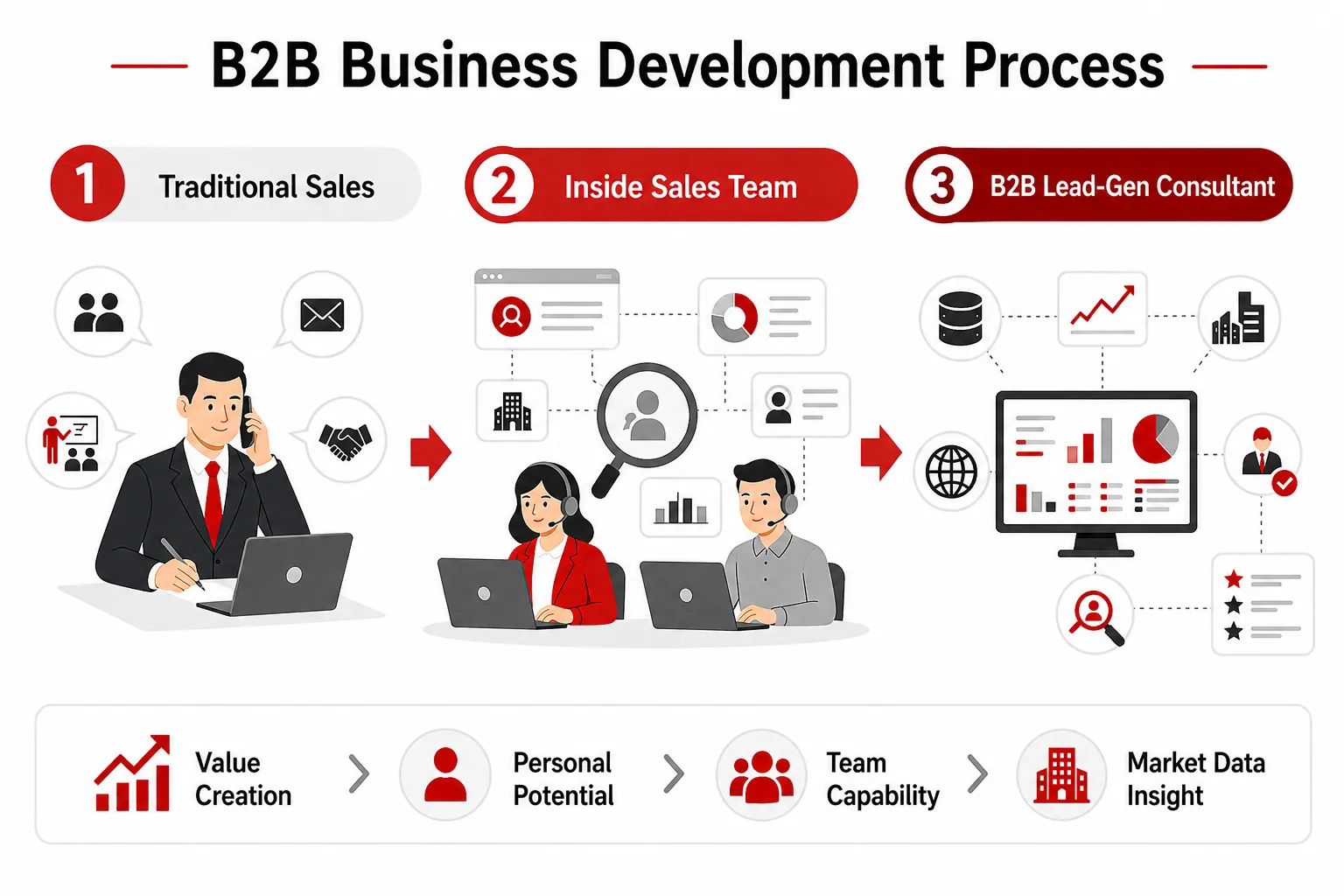
Business Development vs. Sales: How Process Design Affects Close Rates
B2B business development is never a matter of luck. It is built on data and discipline. To consistently acquire new clients, organizations can establish a structured business development SOP that consolidates fragmented tactics into a systematic prospecting engine.
Step 1: Build an Ideal Customer Profile (ICP)
An Ideal Customer Profile (ICP) defines a precise picture of the target company and its decision-making unit, including industry type, company size, geography, seniority level, business intelligence, pain points, and current solution usage. Without a clear ICP, the resulting leads will be cluttered with noise, leading to a waste of costs.
Step 2: Build Your Target Prospect List
Prospect list sources are diverse and can include:
- Government and industry databases: Business registration records, industry association membership directories.
- Digital social platforms: For example, LinkedIn Sales Navigator.
- Events and trade shows: Business cards collected at exhibitions or forums.
- AI Agent tools: Platforms such as Apollo, ZoomInfo, or Sherlock AI to filter qualified targets.
- Dormant CRM contacts: Previously contacted leads that did not convert or have had no engagement for an extended period.
- Cold outreach: Directly acquiring precise B2B leads through outbound prospecting.
Step 3: The BANT Framework – Turning “Data” into “Opportunities”
Once an initial prospect list is secured, the next step is designing the outreach script. Enspyre’s Project Manager Vivian notes that this is a critical stage for gathering market intelligence. All script design follows the BANT framework to ensure key market insights are captured. The same framework can also be applied to configure AI Agents that detect high-potential opportunities and improve efficiency.
- Budget: Confirm whether the target has the purchasing capacity.
- Authority: Bypass non-decision-makers and directly identify individuals with procurement authority.
- Need: Determine whether the prospect is currently facing a problem that needs to be solved.
- Timeline: Understand their procurement cycle and engage at the most opportune moment.
Enspyre Sales Director Sam notes: “The most important thing in cold outreach is earning trust. What captures a decision-maker’s attention is always the problem they are currently losing sleep over.”
Step 4: Cold Outreach Conversation Framework
The most fatal mistake in cold outreach is starting a conversation without preparation. The following conversation framework helps you maintain a clear mental blueprint and guide the prospect through your intended flow:
- Opening (Navigate): Quickly confirm the prospect’s identity and current availability, demonstrating respect for their time.
- Middle (Value): Articulate in 15 seconds why this call is relevant to them.
- Later (Qualify): Use initial questions to assess their BANT status (Budget, Authority, Need, Timeline).
- Close (CTA): Propose a clear next step, such as scheduling a 15-minute online meeting or sending a solution white paper.
Many people are afraid of cold outreach. Enspyre have compiled years of cold outreach techniques and mindset frameworks to help you avoid common pitfalls.
Step 5: Data Insights – Interpreting Opportunities and Potential
Organizations should regularly document business development reports. Leaders should focus on the following indicators:
Quantitative:
- ICP Analysis: Track the MQL/SQL conversion rates to validate whether the ICP is accurate or needs adjustment.
- Conversion Rate Evaluation: Record the complete journey from first contact to successful meeting, through to final close. Analyze whether the sales cycle is shortening and how deal volume is trending.
Qualitative:
- Conversation Key Points: Analyze call patterns to identify which conversation topics or value propositions extend engagement and reduce rejection rates.
- First-Hand Feedback: Collect prospects’ assessments of product needs and their views on competitive alternatives. This is more actionable than any market research report.
Step 6: Build a Reliable Lead Tracking System
Sales teams should accurately classify leads by quality and allocate development resources and follow-up strategies accordingly:
- Hot lead (High Intent, High Value): Initiate intensive follow-up and customized proposals immediately.
- Warm lead(Has Need, Wrong Timing): Enroll in a long-term nurturing plan with regular industry updates to maintain engagement.
- Cold lead (Not interested): Let go decisively and redirect effort toward new cold outreach lists.
B2B Business Development: Key Takeaways
Business development comes down to one principle: find the right people, at the right time, and say the right thing.
A disciplined system, not individual effort, is what breaks through organizational ceilings:
- Top salespeople’s time is too valuable to spend on breaking the ice. Systematizing or outsourcing front-end prospecting, so that top performers can focus on closing, is the highest-ROI use of human capital.
- Business development value goes beyond booking meetings. Every cold conversation yields first-hand market intelligence that is closer to reality than any survey report.
- ICP is a testing metric, not a final answer. ICP is best for testing the market. Continuously validate and adjust, letting market feedback the right answers and getting closer to its revenue targets.
- Use BANT to build a conversation framework. Conversations that actually advance opportunities start by understanding the prospect’s anxiety, not by pitching a product.
- Data tracking makes business development forecastable. Accurately recording conversion rates and cycle data is the only way to determine whether the problem lies in list quality, script design, or execution.
Business development should never be a lone salesperson’s battlefield. It is a team’s shared system of division and support.
FAQ
Q: How should a company evaluate whether its current business development effort justifies significant sales team investment?
Companies should prioritize two core metrics: SQL/MQL conversion rate and new client sales cycle.
Calculate the time from first call to close, then work backwards to determine the volume of qualified opportunities needed to hit annual targets. Compare against headcount costs: if top salespeople are spending more than 40% of their time on cold outreach rather than negotiation, that is a warning sign.
The more effective strategy is precision prospects x professional business development. Rather than training every salesperson to be a cold outreach expert, leveraging an external professional service to filter cold lists into high-quality opportunities allows the internal team to focus on closing and maximizes ROI.
Q: Can AI automation tools fully replace human business development?
In B2B contexts, AI’s core value lies in gathering intelligence data, not replacing the warmth of human interaction. AI’s greatest capability is accurately detecting latent buying signals and optimizing the initial filtering stage of business development.
For example, Enspyre uses AI Agents combined with its proprietary database to identify high-potential prospects, significantly improving both process efficiency and list quality.
Q: Is the traditional method of business development still effective?
Absolutely, and the current trend is deep integration with digital prospecting.
In high-value B2B transactions, digital advertising builds brand awareness, but human-led business development conversations remain the fastest way to establish initial trust and uncover latent needs. For example, Enspyre’s engagement with a U.S. state trade office combined AI signal detection with professional outreach to reach precise decision-makers.
Q: When the majority of team members are failing at cold outreach and business development results are falling short, what steps should leaders take?
The frustration among newer talent typically are “ineffective calls.” This generation is often more comfortable with SNS than live communication, a generational shift that is difficult to change quickly.
Leaders can restructure KPIs around “effective conversations held” and “market intelligence gathered”, and encourage the team to reframe rejection: the reasons prospects decline are also valuable data points for opportunity assessment. When salespeople realize business development is not just about being turned down, but about bringing back meaningful market intelligence, their sense of accomplishment improves.
If the internal team continues to struggle, engaging the Enspyre team ensures prospecting momentum is maintained without interruption.
Not sure where your business development process is breaking down?
Tell us about your business development goals and we’ll show you how